Atlantic Puffins: A Complete Guide To Seeing Them In The Wild
The first time you see a puffin in the wild, the immediate reaction is almost always the same: disbelief that something this vivid, this comical, this improbable, is a real bird. The painted beak, crimson, yellow and pale blue-grey, reissued every spring in fresh breeding colours, looks designed by a committee that could not decide whether to make a bird or a toy. The orange feet are almost offensive in their brightness. And then it opens its wings and throws itself off a cliff into a force-eight Atlantic gale, and you understand that none of this was designed for your entertainment.
Atlantic puffins are extraordinary animals. They spend most of their lives at sea, far offshore, in conditions that would be dangerous to most wildlife. They are built for the ocean: dense, torpedo-shaped, with wings that beat up to four hundred times a minute to keep them airborne and underwater drive them to depths of sixty metres in pursuit of sand eels and sprats. They come to land reluctantly, for the sole reason to mate and rear their puffling. The short window when they crowd the clifftops and grassy headlands of the North Atlantic is one of the most exciting events in the British and Icelandic wildlife calendar.
This is everything you need to know about puffins: what they are, where to find them, when to go, how to watch them well, and why, despite their apparent abundance in certain places, they need our attention and care.

About the Puffin
Identification
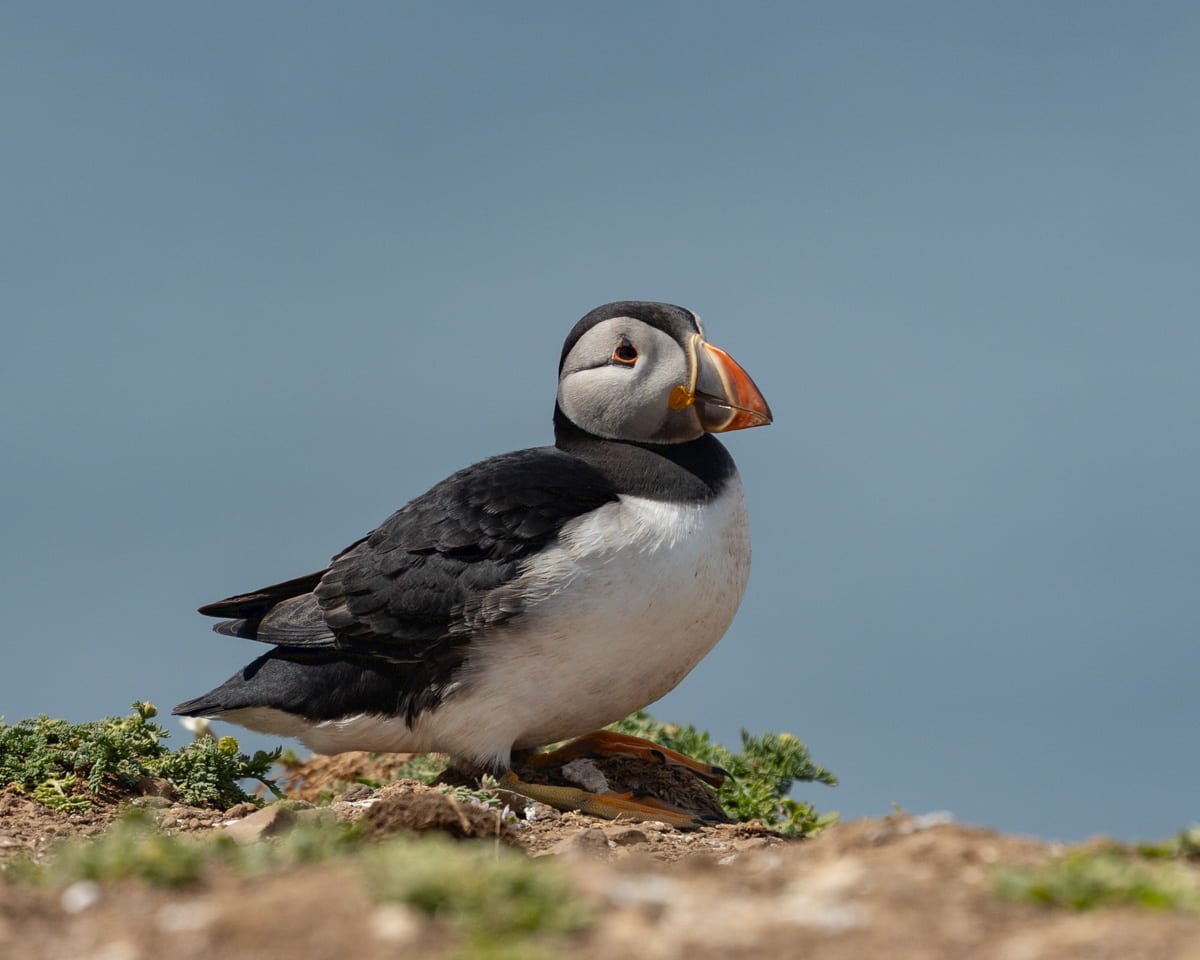
The Atlantic puffin (Fratercula arctica) is unmistakable in summer plumage. The breeding adult has a black back and crown, white underparts and face, and the extraordinary multi-coloured bill that makes it the most recognisable seabird in the world. The feet are bright orange. The eye is small, surrounded by a red orbital ring and a triangular patch of grey skin that gives the bird its characteristic doleful expression.
In winter, the face turns grey, the bill sheds its colourful outer plates (called rhamphotheca) to reveal a smaller, drabber structure beneath, and the feet fade. The bird at sea in January looks almost nothing like the creature standing on the clifftop in June.
They are roughly the same as a starling when folded up, though the chest is broader and the posture more upright. In flight, the rapid wingbeat and short, rugby ball-shaped body distinguish it from razorbills and guillemots. They are surprisingly light, mostly feather and hollow bone around the muscles needed to power a life at sea.
Voice and Behaviour
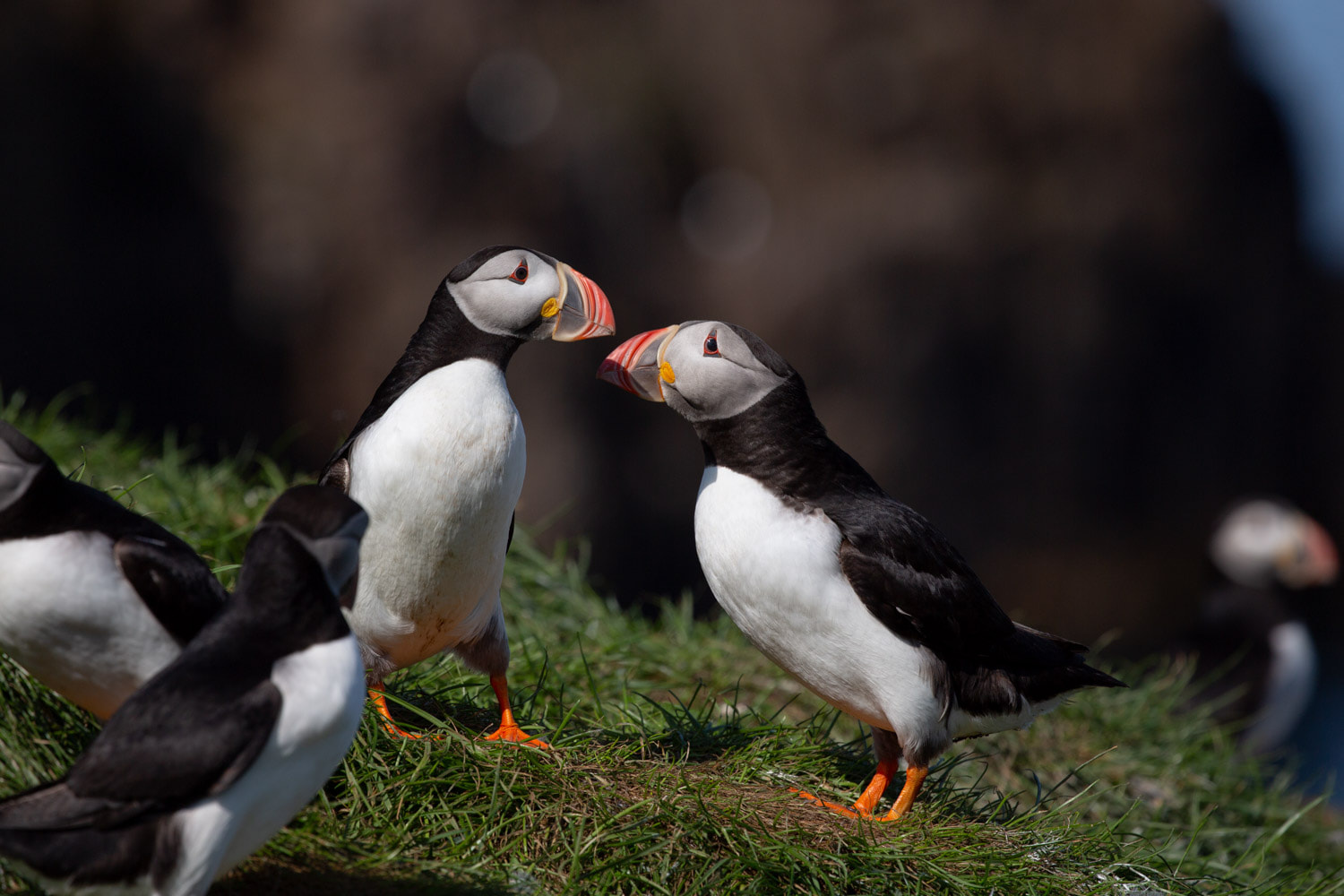
Puffins are vocal at the colony, though not loudly. The call is a low, groaning arr-arr-arr, more moaning than musical and can be heard from inside the burrow or from birds performing the social displays that occupy much of their time at the colony. Watch for billing: two birds pressing their beaks together and rapidly shaking their heads, a bonding behaviour that looks and probably is affectionate.
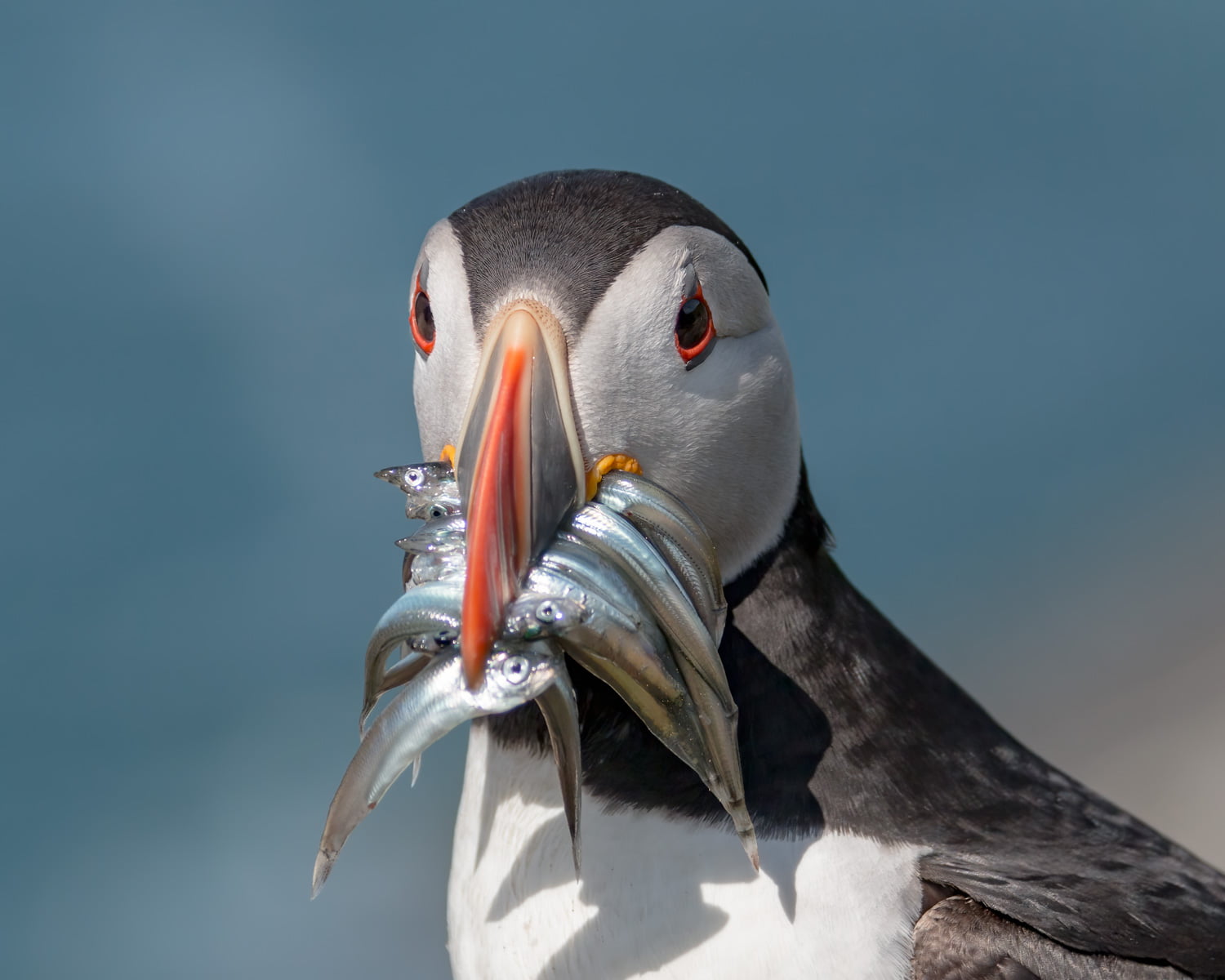
On the clifftop, puffins stand and stare with an air of tremendous self-importance. They preen, they quarrel with neighbours, they carry beakfuls of nesting material, and from late May onwards, when chicks are in the burrows, they make repeated flights to sea and return with spectacular loads of sand eels held crossways in the bill, sometimes twenty or more at a time. Watching a puffin arrive at the colony with its beak so full it can barely see over the top is one of the great wildlife comedy moments.
Life History
Puffins are long-lived, and individuals of thirty years or more are known. They are highly faithful to their breeding sites and partners. Most return to the same burrow and the same mate year after year. They dig their own burrows in soft, peaty clifftop turf or use natural rock crevices on harder substrates. A single egg is laid, and both parents share incubation over about six weeks.
The chick, called a puffling, stays in the burrow for six to seven weeks and is fed on fish by both parents. Then, one night, usually in late July or early August, it crawls out of the burrow alone, launches itself from the clifftop, and heads out to sea. It will not touch land again for several years. The parents depart around the same time, leaving as suddenly as they arrived.

Where Puffins Are Found
Puffins breed across the North Atlantic, from Canada and Greenland in the west to Iceland, the Faroe Islands, Norway and the British Isles in the east. The global population is estimated at several million pairs, although numbers have declined significantly across much of the range, and the species is now classified as Vulnerable on the IUCN Red List.
The map of their range is defined by cold, productive ocean: puffins depend on the fish shoals that cold, nutrient-rich Atlantic and Arctic waters produce. They are birds of the sea cliffs at the edge of the temperate and sub-arctic world.
United Kingdom and Ireland
The British Isles hold a significant proportion of the global population, estimated at around ten per cent. These are spread across colonies from the chalk cliffs of Yorkshire to the remote Atlantic edges of Shetland. Key colonies include Skomer Island in Pembrokeshire (the largest in southern Britain), the Farne Islands in Northumberland, Bempton Cliffs in Yorkshire (the most accessible mainland site), the Isle of May in the Firth of Forth, and numerous Shetland and Orkney colonies. Ireland hosts colonies on Rathlin Island and the Saltee Islands, among others.
Iceland
Iceland holds the world’s largest Atlantic puffin population and at certain estimates, more than half of the global breeding total. The scale of Icelandic colonies is difficult to comprehend until you are standing on the cliffs at Látrabjarg, the westernmost point of Europe, watching hundreds of thousands of birds on a cliff face several kilometres long. Other major sites include the Westman Islands (Vestmannaeyjar), where the famous Puffling Patrol rescues disoriented fledglings each August, and Borgarfjörður Eystri in the east, an intimate, accessible colony right at the harbour edge.
Faroe Islands
Mykines, the westernmost Faroe island, is for many people the single finest puffin experience available anywhere. The island is remote, the access weather-dependent, and the number of visitors is now strictly limited, but those who reach it walk through an active nesting ground on the path to the lighthouse, with puffins at arm’s length on either side. The Faroe Islands as a whole have significant puffin populations, though Mykines is the standout site.
Norway
Norway’s Atlantic and Arctic coast holds large puffin colonies, with three sites of particular note: Lovund in Nordland, famous for the mass spring arrival traditionally observed on 14 April; Hornøya in Finnmark, an island above the Arctic Circle reachable by a short boat trip from Vardø; and Runde in Møre og Romsdal, the most southerly and most accessible Norwegian site. Hornøya is the place to see puffins if you want them nestled in a snow-covered landscape.
Canada
Newfoundland is the puffin capital of the Americas. Witless Bay Ecological Reserve, south of St John’s, holds the largest Atlantic puffin colony in eastern North America. Elliston, a small coastal community on Trinity Bay, has birds nesting on sea stacks within easy walking distance of the road. Both are accessible by boat trip or on foot and best visited from June to August.
When to See Puffins
Timing is everything with puffins. They are absent from land for more than half the year, usually from August or September until the following spring, and the window to see them on land is shorter and more variable than many people expect.
| Region | Arrival | Peak Activity | Sand Eel Season | Departure |
|---|---|---|---|---|
| South UK (Skomer, Lundy) | Late March–April | May–June | Late May–June | Late July |
| North UK (Farnes, Isle of May) | April | May–June | Late May–June | Late July |
| Scotland (Shetland, Orkney) | Late March | May–July | June–July | Late July–August |
| Iceland | April–May | June–July | June–July | August |
| Faroe Islands | April–May | June–July | June–July | August |
| Norway (Arctic) | April | June–July | June–July | August |
| Canada (Newfoundland) | April–May | June–July | June–July | August |
The best time for UK colonies is mid-May to late June. This is when birds are most active around the colony, carrying sand eels, billing, standing guard at burrow entrances, and the colony is at full density. By late July, adults begin to slip away from UK colonies, often before their chicks have fledged.
For Iceland and Norway, late June to mid-July is the equivalent peak: adults are busy feeding chicks, and the long Arctic evenings give extraordinary light for photography.
One more timing note: puffins are most active at the colony early in the morning and in the evening. Midday in bright sunshine is often the quietest time. Dawn in late May at Skomer, with puffins arriving in clouds from the sea, is one of the finest wildlife experiences available in Britain.
Photographing Puffins
Puffins are one of the most rewarding wildlife photography subjects in the world as they are vivid in colour, tolerant of close approach in habituated colonies, and endlessly active during the breeding season. The challenge is not getting close; it is resisting the temptation to take the same picture that ten thousand photographers have taken before you.
Settings to start with: Fast shutter speed is essential in flight use, 1/2000s as a minimum guide, 1/3200s preferred in good light. For birds on the ground, 1/800s is usually sufficient to freeze movement while retaining some background blur. Aperture priority at f/5.6–f/8 gives depth of field without losing sharpness. In the colony, puffins are often close enough that the background goes soft regardless of aperture.
The sand eel shot: a puffin returning to the burrow with a bill full of fish is the classic image, and June is the month to get it. Position yourself low, at eye level, and wait near an active burrow entrance. Birds return on a reasonably predictable cycle if undisturbed.
Get low: Almost every great puffin photograph is taken from a prone position. Standing over a puffin gives you the top of its head; lying at eye level gives you that direct, character-filled gaze.
For flight shots: The cliff-edge is your friend. Puffins launching from the top of the colony, or returning from the sea at low altitude, give you birds against a clean sky or blurred green background. Anticipate approach lines as they tend to use the same flight corridors repeatedly.
The full photography guide covering settings, approach technique, best locations for each type of shot, ethical practice, and post-processing notes is in the Complete Puffin Guide.
Conservation Status
The Atlantic puffin is classified as Vulnerable on the IUCN Red List, a status assigned in 2015 and not yet reversed. The global population, while still numbering in the millions, has declined significantly across much of the European range. In Iceland, some colonies have experienced severe breeding failures in recent decades. In the UK, declines have been recorded at several Scottish sites, though colonies in Wales and northeast England have remained more stable.
The primary driver is food availability. Puffins depend on sand eels and similar small, shoaling fish that are concentrated near the sea surface in cold, productive water. Warming seas alter the timing and distribution of these shoals, decoupling the fish supply from the period when puffin chicks most need feeding. Years of poor sand eel availability result in widespread chick starvation and breeding failure.

Additional pressures include bycatch in fishing gear (puffins caught in gill nets set for other species), rat predation at some colonies, and, in some parts of the range, direct harvesting. This is still legal in Iceland and the Faroe Islands, though increasingly restricted and culturally contested.
The good news is that puffin colonies in the UK are actively monitored and protected. Skomer, the Farne Islands, the Isle of May and Sumburgh Head are all managed or protected by conservation organisations, and the long-term data collected at these sites is valuable to the understanding of seabird population dynamics globally. Visiting responsibly by staying on paths, keeping clear of burrow entrances and following site guidance supports both the birds and the conservation infrastructure that protects them.

The Complete Puffin Guide
Everything covered here and much more is in the Complete Puffin Guide. It covers the full natural history of the Atlantic puffin, detailed guides to every major UK colony, and dedicated chapters on Iceland, the Faroe Islands, Norway and Canada. There is a full puffin photography guide with settings, locations and approach technique, and practical advice on trip planning, boat trips, and getting the most from every visit.
It is the reference guide for anyone serious about seeing puffins, whether you are planning a morning at Bempton or a week in the Westfjords.
Want to know more about puffins around the world?
Complete Guide to Puffins
This ebook includes information about the puffin colonies, where to find them and how to visit responsibly. With 120 pages of information, maps and beautiful photographs, it will help you see the puffins on your next summer adventure in the UK, Ireland, Iceland and other Atlantic coast regions.
UK Puffin Colony Map
Get my favourite puffin colonies in a useful Google My Maps. The map includes the best visiting months, access notes and what you can see beyond puffins at each site. Free when you join the newsletter.
Everything Puffins
-


Where To See Puffins On Shetland
-
Where To See Puffins On Orkney
-

The Best Places To See Puffins In The UK
-

Where To See Puffins In Ireland and Northern Ireland
-

Where To See Puffins In Scotland
-

Where To See Puffins In England
-

Where To See Puffins On The Scottish Islands
-

Where To See Puffins: UK, Iceland And The Best Places Worldwide
-

Where To See Puffins In Wales: Best Locations And When To Visit
-


How To Photograph Puffins: The Complete Field Guide
-

Where to see puffins in Iceland – 6 of the best places


